To solve any problem, an algorithmic approach must be followed.
This approach is divided into two essential phases:
1- The analysis phase
2- The design phase
We will detail each part of this approach.
1- Analysis phase:
In this phase, we determine three essential elements:
a- The data
b- The desired result
c- The processing
2- Design phase:
It is in this phase that we must write our program, based on the analysis phase.
Example:
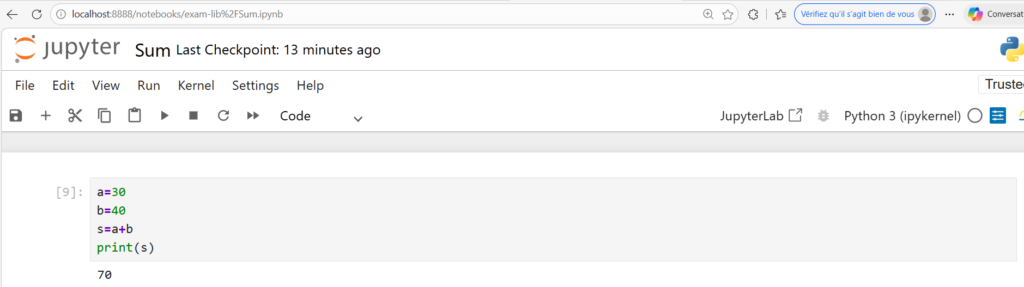
We are going to try to write a small program in Python that allows us to calculate the sum of two numbers: a=30 and b=40.
1-Analysis phase:
a- The data: a=30 and b=40
b- The desired result: The sum (s)
C- The processing (or the formula): S=a+b
Practical section
All the programs in our courses are written using “Jupyter Notebook”.
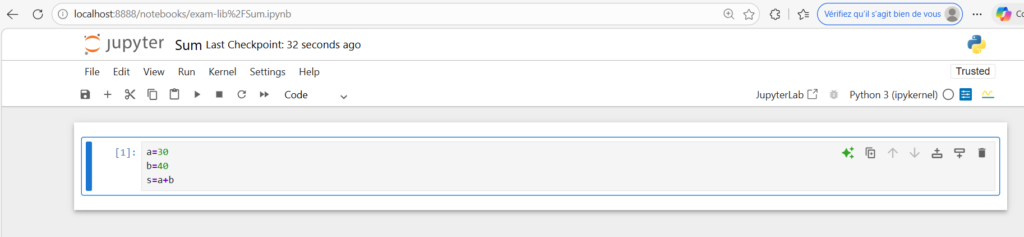
Now, we need to display the result on the screen; that’s why we have what’s called an output instruction, “print”.
Output Instruction: Print
The output instruction allows you to either display the contents of a variable or display a message. The keyword used is “print”.
Let x be a variable containing 5 as its value.
To display the value of x, we will write: print(x)

To display the message “hello” on the screen, we will write print(‘hello’)

Let’s return now to our program that calculates the sum of a and b.
To display the result of the sum of a and b, we use the print statement:
print(s)